The Big Money Behind the Big Lie
Donald Trump’s attacks on democracy are being promoted by rich and powerful conservative groups that are determined to win at all costs.
By Jane Mayer August 2, 2021 The New Yorker
https://www.newyorker.com/magazine/2021/08/09/the-big-money-behind-the-big-lie
It was tempting to dismiss the show unfolding inside the Dream City Church in Phoenix, Arizona, as an unintended comedy. One night in June, a few hundred people gathered for the première of “The Deep Rig,” a film financed by the multimillionaire founder of Overstock.com, Patrick Byrne, who is a vocal supporter of former President Donald Trump. Styled as a documentary, the movie asserts that the 2020 Presidential election was stolen by supporters of Joe Biden, including by Antifa members who chatted about their sinister plot on a conference call. The evening’s program featured live appearances by Byrne and a local QAnon conspiracist, BabyQ, who claimed to be receiving messages from his future self. They were joined by the film’s director, who had previously made an exposé contending that the real perpetrators of 9/11 were space aliens.
But the event, for all its absurdities, had a dark surprise: “The Deep Rig” repeatedly quotes Doug Logan, the C.E.O. of Cyber Ninjas, a Florida-based company that consults with clients on software security. In a voice-over, Logan warns, “If we don’t fix our election integrity now, we may no longer have a democracy.” He also suggests, without evidence, that members of the “deep state,” such as C.I.A. agents, have intentionally spread disinformation about the election. Although it wasn’t the first time that Logan had promoted what has come to be known as the Big Lie about the 2020 election—he had tweeted unsubstantiated claims that Trump had been victimized by voter fraud—the film offered stark confirmation of Logan’s entanglement in fringe conspiracies. Nevertheless, the president of the Arizona State Senate, Karen Fann, has put Logan’s company in charge of a “forensic audit”—an ongoing review of the state’s 2020 Presidential vote. It’s an unprecedented undertaking, with potentially explosive consequences for American democracy.
Approximately 2.1 million Presidential votes were cast in Maricopa County, which includes Phoenix and accounts for most of the state’s population. In recent years, younger voters and people of color have turned the county’s electorate increasingly Democratic—a shift that helped Biden win the traditionally conservative state, by 10,457 votes. Since the election, the county has become a focus of ire for Trump and his supporters. By March, when Logan’s company was hired, the county had already undergone four election audits, all of which upheld the outcome. Governor Doug Ducey, a Republican and a former Trump ally, had certified Biden’s victory. But Trump’s core supporters were not assuaged.
As soon as the Fox News Decision Desk called the state for Biden, at 11:20 p.m. on November 3rd, Trump demanded that the network “reverse this!” When Fox held firm, he declared, “This is a major fraud.” By the time of the “Deep Rig” première, the standoff had dragged on for more than half a year. The Cyber Ninjas audit was supposed to conclude in May, but at the company’s request Fann has repeatedly extended it. On July 28th, the auditors completed a hand recount, but they are still demanding access to the computer routers used by Maricopa County and also want to scrutinize images of mail-in-ballot envelopes. The U.S. Department of Justice has warned that “private actors who have neither experience nor expertise in handling” ballots could face prosecution for failing to follow federal audit rules. Trump, meanwhile, has fixated on Arizona’s audit, describing it as a step toward his “reinstatement.” On July 24th, he appeared in Phoenix for a “Rally to Protect Our Elections,” and said, “I am not the one trying to undermine American democracy—I’m the one trying to save American democracy.” Predicting that the audit would vindicate him, he rambled angrily for nearly two hours about having been cheated, calling the election “a scam—the greatest crime in history.”
In June, I stood in the bleachers at the Veterans Memorial Coliseum in Phoenix, where the audit was taking place, and witnessed people examining carton after carton of paper ballots cast by Arizonans last fall. Some inspectors used microscopes to investigate surreal allegations: that some ballots had been filled out by machines or were Asian counterfeits with telltale bamboo fibres. Other inspectors looked for creases in mail-in ballots, to determine whether they had been legitimately sent in envelopes or—as Trump has alleged—dumped in bulk.
As the audit has unfolded, various violations of professional norms have been observed, including inspectors caught with pens whose ink matched what was used on ballots. One auditor turned out to have been an unsuccessful Republican candidate during the election. As I watched the proceedings, black-vested paid supervisors monitored the process, but their role was cloaked in secrecy. The audit is almost entirely privately funded, and a county judge in Arizona recently ordered the State Senate to disclose who is paying for it. Last week, Cyber Ninjas acknowledged having received $5.7 million in private donations, most of it from nonprofit groups led by Trump allies who live outside Arizona, including Byrne.
I was joined in the bleachers by Ken Bennett, a former Arizona secretary of state and a Republican, whom the State Senate had designated its liaison to the audit. He acknowledged that, if the auditors end up claiming to have found large discrepancies, “that will of course be very inflammatory.” Indeed, a recent incendiary claim by the auditors—that the vote had tallied about seventy thousand more mail-in ballots than had been postmarked—prompted one Republican state senator to propose a recall of Arizona’s electoral votes for Biden. (In fact, the auditors misunderstood what they were counting.) Nevertheless, Bennett defended the audit process: “It’s important to prove to both sides that the election was done accurately and fairly. If we lurch from one election to another with almost half the electorate thinking the election was a fraud, it’s going to rip our country apart.”
Many experts on democratic governance, however, believe that efforts to upend long-settled election practices are what truly threaten to rip the country apart. Chad Campbell, a Democrat who was the minority leader in the Arizona House of Representatives until 2014, when he left to become a consultant in Phoenix, has been shocked by the state’s anti-democratic turn. For several years, he sat next to Karen Fann when she was a member of the House, and in his view she’s gone from being a traditional Republican lawmaker to being a member of “Trump’s cult of personality.” He said, “I don’t know if she believes it or not, or which would be worse.” Arizona, he added, is in the midst of a “nonviolent overthrow in some ways—it’s subtle, and not in people’s face because it’s not happening with weapons. But it’s still a complete overthrow of democracy. They’re trying to disenfranchise everyone who is not older white guys.”
Arizona is hardly the only place where attacks on the electoral process are under way: a well-funded national movement has been exploiting Trump’s claims of fraud in order to promote alterations to the way that ballots are cast and counted in forty-nine states, eighteen of which have passed new voting laws in the past six months. Republican-dominated legislatures have also stripped secretaries of state and other independent election officials of their power. The chair of Arizona’s Republican Party, Kelli Ward, has referred to the state’s audit as a “domino,” and has expressed hope that it will inspire similar challenges elsewhere.
Ralph Neas has been involved in voting-rights battles since the nineteen-eighties, when, as a Republican, he served as the executive director of the Leadership Conference on Civil Rights. He has overseen a study of the Arizona audit for the nonpartisan Century Foundation, and he told me that, though the audit is a “farce,” it may nonetheless have “extraordinary consequences.” He said, “The Maricopa County audit exposes exactly what the Big Lie is all about. If they come up with an analysis that discredits the 2020 election results in Arizona, it will be replicated in other states, furthering more chaos. That will enable new legislation. Millions of Americans could be disenfranchised, helping Donald Trump to be elected again in 2024. That’s the bottom line. Maricopa County is the prism through which to view everything. It’s not so much about 2020—it’s about 2022 and 2024. This is a coördinated national effort to distort not just what happened in 2020 but to regain the House of Representatives and the Presidency.”
Richard Hasen, a law professor at the University of California, Irvine, and one of the country’s foremost election-law experts, told me, “I’m scared shitless.” Referring to the array of new laws passed by Republican state legislatures since the 2020 election, he said, “It’s not just about voter suppression. What I’m really worried about is election subversion. Election officials are being put in place who will mess with the count.”
Arizona’s secretary of state, Katie Hobbs, whose office has authority over the administration of elections, told me that the conspiracy-driven audit “looks so comical you have to laugh at it sometimes.” But Hobbs, a Democrat, who is running for governor, warned, “It’s dangerous. It’s feeding the kind of misinformation that led to the January 6th insurrection.” QAnon followers have been celebrating the audit as the beginning of a “Great Awakening” that will eject Biden from the White House. She noted, “I’ve gotten death threats. I’ve had armed protestors outside my house. Every day, there is a total barrage of social media to our office. We’ve had to route our phones to voice mail so that no one has to listen to it. It can be really traumatizing. I feel beaten up.” She added, “But I’m not going to cave to their tactics—because I think they’re laying the groundwork to steal the 2024 elections.”
Although the Arizona audit may appear to be the product of local extremists, it has been fed by sophisticated, well-funded national organizations whose boards of directors include some of the country’s wealthiest and highest-profile conservatives. Dark-money organizations, sustained by undisclosed donors, have relentlessly promoted the myth that American elections are rife with fraud, and, according to leaked records of their internal deliberations, they have drafted, supported, and in some cases taken credit for state laws that make it harder to vote.
Senator Sheldon Whitehouse, a Democrat from Rhode Island who has tracked the flow of dark money in American politics, told me that a “flotilla of front groups” once focussed on advancing such conservative causes as capturing the courts and opposing abortion have now “more or less shifted to work on the voter-suppression thing.” These groups have cast their campaigns as high-minded attempts to maintain “election integrity,” but Whitehouse believes that they are in fact tampering with the guardrails of democracy.
One of the movement’s leaders is the Heritage Foundation, the prominent conservative think tank in Washington, D.C. It has been working with the American Legislative Exchange Council (alec)—a corporate-funded nonprofit that generates model laws for state legislators—on ways to impose new voting restrictions. Among those deep in the fight is Leonard Leo, a chairman of the Federalist Society, the legal organization known for its decades-long campaign to fill the courts with conservative judges. In February, 2020, the Judicial Education Project, a group tied to Leo, quietly rebranded itself as the Honest Elections Project, which subsequently filed briefs at the Supreme Court, and in numerous states, opposing mail-in ballots and other reforms that have made it easier for people to vote.
Another newcomer to the cause is the Election Integrity Project California. And a group called FreedomWorks, which once concentrated on opposing government regulation, is now demanding expanded government regulation of voters, with a project called the National Election Protection Initiative.
These disparate nonprofits have one thing in common: they have all received funding from the Lynde and Harry Bradley Foundation. Based in Milwaukee, the private, tax-exempt organization has become an extraordinary force in persuading mainstream Republicans to support radical challenges to election rules—a tactic once relegated to the far right. With an endowment of some eight hundred and fifty million dollars, the foundation funds a network of groups that have been stoking fear about election fraud, in some cases for years. Public records show that, since 2012, the foundation has spent some eighteen million dollars supporting eleven conservative groups involved in election issues.
It might seem improbable that a low-profile family foundation in Wisconsin has assumed a central role in current struggles over American democracy. But the modern conservative movement has depended on leveraging the fortunes of wealthy reactionaries. In 1903, Lynde Bradley, a high-school dropout in Milwaukee, founded what would become the Allen-Bradley company. He was soon joined by his brother Harry, and they got rich by selling electronic instruments such as rheostats. Harry, a John Birch Society founding member, started a small family foundation that initially devoted much of its giving to needy employees and to civic causes in Milwaukee. In 1985, after the brothers’ death, their heirs sold the company to the defense contractor Rockwell International, for $1.65 billion, generating an enormous windfall for the foundation. The Bradley Foundation remains small in comparison with such liberal behemoths as the Ford Foundation, but it has become singularly preoccupied with wielding national political influence. It has funded conservative projects ranging from school-choice initiatives to the controversial scholarship of Charles Murray, the co-author of the 1994 book “The Bell Curve,” which argues that Blacks are less likely than whites to join the “cognitive elite.” And, at least as far back as 2012, it has funded groups challenging voting rights in the name of fighting fraud.
Since the 2020 election, this movement has evolved into a broader and more aggressive assault on democracy. According to some surveys, a third of Americans now believe that Biden was illegitimately elected, and nearly half of Trump supporters agree that Republican legislators should overturn the results in some states that Biden won. Jonathan Rauch, of the Brookings Institution, recently told The Economist, “We need to regard what’s happening now as epistemic warfare by some Americans on other Americans.” Pillars of the conservative establishment, faced with a changing U.S. voter population that threatens their agenda, are exploiting Trump’s contempt for norms to devise ways to hold on to power. Senator Whitehouse said of the campaign, “It’s a massive covert operation run by a small group of billionaire élites. These are powerful interests with practically unlimited resources who have moved on to manipulating that most precious of American gifts—the vote.”
An animating force behind the Bradley Foundation’s war on “election fraud” is Cleta Mitchell, a fiercely partisan Republican election lawyer, who joined the organization’s board of directors in 2012. Until recently, she was virtually unknown to most Americans. But, on January 3rd, the Washington Post exposed the contents of a private phone call, recorded the previous day, during which Trump threatened election officials in Georgia with a “criminal offense” unless they could “find” 11,780 more votes for him—just enough to alter the results. Also on the call was Mitchell, who challenged the officials to provide records proving that dead people hadn’t cast votes. The call was widely criticized as a rogue effort to overturn the election, and Foley & Lardner, the Milwaukee-based law firm where Mitchell was a partner, announced that it was “concerned” about her role, and then parted ways with her. Trump’s call prompted the district attorney in Fulton County, Georgia, to begin a criminal investigation.
In a series of e-mails and phone calls with me, Mitchell adamantly defended her work with the Trump campaign, and said that in Georgia, where she has centered her efforts, “I don’t think we can say with certainty who won.” She told me that there were countless election “irregularities,” such as voters using post-office boxes as their residences, in violation of state law. “I believe there were more illegal votes cast than the margin of victory,” she said. “The only remedy is a new election.” Georgia’s secretary of state rejected her claims, but Mitchell insists that the decision lacked a rigorous evaluation of the evidence. With her support, diehard conspiracy theorists are still litigating the matter in Fulton County, which includes most of Atlanta. Because they keep demanding that election officials prove a negative—that corruption didn’t happen—their requests to keep interrogating the results can be repeated almost indefinitely. Despite three independent counts of Georgia’s vote, including a hand recount, all of which confirmed Biden’s victory, Mitchell argues that “Trump never got his day in court,” adding, “There are a lot of miscarriages of justice I’ve seen and experienced in my life, and this was one of them.”
Mitchell, who is seventy, has warm friendships with people in both parties, and she often appears grandmotherly, in pastel knit suits and reading glasses. But, like Angela Lansbury in “The Manchurian Candidate,” to whom she bears a striking resemblance, she should not be underestimated. She began her political career in Oklahoma, as an outspoken Democrat and a champion of the Equal Rights Amendment. She was elected to the state legislature in her twenties, but then lost a bid for lieutenant governor, in 1986. She told me that she subsequently underwent a political conversion: when her stepson squandered the college tuition that she was paying, she turned against the idea of welfare in favor of personal responsibility, and began reading conservative critiques of liberalism. When I first interviewed her for this magazine, in 1996, she told me that “overreaching government regulation is one of the great scandals of our times.”
On behalf of Republican candidates and groups, she began to fight limits on campaign spending. She also represented numerous right-wing nonprofits, including the National Rifle Association, whose board she joined in the early two-thousands. A former N.R.A. official recently told the Guardian that Mitchell was the “fringe of the fringe,” and a Republican voting-rights lawyer said that “she tells clients what they want to hear, regardless of the law or reality.”
In our conversations, Mitchell mocked what she called the mainstream media’s “narrative” of a “vast right-wing conspiracy to suppress the vote of Black people,” and insisted that the fraud problem was significant. “I actually think your readers need to hear from people like me—believe it or not, there are tens of millions of us,” she wrote. “We are not crazy. At least not to us. We are intelligent and educated people who are very concerned about the future of America. And we are among the vast majority of Americans who support election-integrity measures.” Echoing what has become the right’s standard talking point, she declared that her agenda for elections is “to make it harder to cheat.”
Mitchell told me that the Democrats used the pandemic as a “great pretext” to “be able to cheat”: they caused “administrative chaos” by changing rules about early and absentee voting, and they didn’t adequately police fraud. She denied that race had motivated her actions in Georgia. Yet, in an e-mail to me, she said that Democrats are “using black voters as a prop to accomplish their political objectives.”
Few experts have found Mitchell’s evidence convincing. On November 12, 2020, the Trump Administration’s own election authorities declared the Presidential vote to be “the most secure in American history.” It is true that in many American elections there are small numbers of questionable ballots. An Associated Press investigation found that, in 2020, a hundred and eighty-two of the 3.4 million ballots cast in Arizona were problematic. Four of the ballots have led to criminal charges. But the consensus among nonpartisan experts is that the amount of fraud, particularly in major races, is negligible. As Phil Keisling, a former secretary of state in Oregon, who pioneered universal voting by mail, has said, “Voters don’t cast fraudulent ballots for the same reason counterfeiters don’t manufacture pennies—it doesn’t pay.”
What explains, then, the hardening conviction among Republicans that the 2020 race was stolen? Michael Podhorzer, a senior adviser to the president of the A.F.L.-C.I.O., which invested deeply in expanding Democratic turnout in 2020, suggests that the two parties now have irreconcilable beliefs about whose votes are legitimate. “What blue-state people don’t understand about why the Big Lie works,” he said, is that it doesn’t actually require proof of fraud. “What animates it is the belief that Biden won because votes were cast by some people in this country who others think are not ‘real’ Americans.” This anti-democratic belief has been bolstered by a constellation of established institutions on the right: “white evangelical churches, legislators, media companies, nonprofits, and even now paramilitary groups.” Podhorzer noted, “Trump won white America by eight points. He won non-urban areas by over twenty points. He is the democratically elected President of white America. It’s almost like he represents a nation within a nation.”
Alarmism about election fraud in America extends at least as far back as Reconstruction, when white Southerners disenfranchised newly empowered Black voters and politicians by accusing them of corruption. After the passage of the Voting Rights Act of 1965, some white conservatives were frank about their hostility to democracy. Forty years ago, Paul Weyrich, who helped establish the Heritage Foundation and other conservative groups, admitted, “I don’t want everybody to vote. As a matter of fact, our leverage in the elections quite candidly goes up as the voting populace goes down.”
Like many conservatives of her generation, Cleta Mitchell was galvanized by the disputed 2000 election, in which George W. Bush and Al Gore battled for weeks over the outcome in Florida. She repeatedly spoke out on behalf of Bush, who won the state by only five hundred and thirty-seven votes. A dispute over recounts ended up at the Supreme Court.
Few people noticed at the time, but in that case, Bush v. Gore, Chief Justice William Rehnquist, along with Antonin Scalia and Clarence Thomas, hinted at a radical reading of the Constitution that, two decades later, undergirds many of the court challenges on behalf of Trump. In a concurring opinion, the Justices argued that state legislatures have the plenary power to run elections and can even pass laws giving themselves the right to appoint electors. Today, the so-called Independent Legislature Doctrine has informed Trump and the right’s attempts to use Republican-dominated state legislatures to overrule the popular will. Nathaniel Persily, an election-law expert at Stanford, told me, “It’s giving intellectual respectability to an otherwise insane, anti-democratic argument.”
Barack Obama’s election in 2008 made plain that the voting-rights wars were fuelled, in no small part, by racial animus. Bigoted conspiracists, including Trump, spent years trying to undermine the result by falsely claiming that Obama wasn’t born in America. Birtherism, which attempted to undercut a landmark election in which the turnout rate among Black voters nearly matched that of whites, was a progenitor of the Big Lie. As Penda Hair, a founder of the Advancement Project, a progressive voting-rights advocacy group, told me, conservatives were looking at Obama’s victory “and saying, ‘We’ve got to clamp things down’—they’d always tried to suppress the Black vote, but it was then that they came up with new schemes.”
Mitchell was at the forefront of the right’s offensive. In 2010, she accused the Majority Leader of the Senate, the Democrat Harry Reid, who was running for reëlection in Nevada, of planning “to steal this election if he can’t win it outright.” Her evidence was that Democrats in the state had provided “clearly illegal” free food at voter-turnout events—a negligible infraction, given that Reid won by more than forty thousand votes.
A year later, Mitchell successfully defended Trump, who had been exploring a Presidential bid, against charges that he had taken illegal campaign contributions. She had been recommended to Trump by Chris Ruddy, the founder of the conservative media company Newsmax, which was also a Mitchell client. Later, Ruddy introduced the future President to Mitchell over dinner at Mar-a-Lago. (She told me that she found Trump “gracious,” and noted that, since the 2020 election, she has talked with him “pretty often.”)
In 2013, the Supreme Court struck down a key section of the Voting Rights Act, eliminating the Justice Department’s power to screen proposed changes to election procedures in states with discriminatory histories, one of which was Arizona. Terry Goddard, a former Arizona attorney general and a Democrat, told me that “the state has a history of voter suppression, especially against Native Americans.” Before Rehnquist became a Supreme Court Justice, in 1971, he lived in Arizona, where he was accused of administering literacy tests to voters of color. In the mid-two-thousands, Goddard recalled, Republican leaders erected many barriers aimed at deterring Latino voters, some of which the courts struck down. But the 2013 Supreme Court ruling initiated a new era of election manipulation.
Around this time, Mitchell became a director at the Bradley Foundation. Among the board members were George F. Will, the syndicated columnist, and Robert George, a Princeton political philosopher known for his defense of traditional Catholic values. By 2017, Will, who has been a critic of Trump, had stepped down from the Bradley board. But George has continued to serve as a director, even as the foundation has heavily funded groups promulgating the falsehood that election fraud is widespread in America, particularly in minority communities, and sowing doubt about the legitimacy of Biden’s win. The foundation, meanwhile, has given nearly three million dollars to programs that George established at Princeton. He has written in praise of Pence’s refusal to decertify Biden’s election, and has lamented that so many Americans believe, “wrongly,” that “the election was ‘stolen.’ ” But he declined to discuss with me why, then, he serves on the Bradley Foundation’s board.
The board includes Art Pope, the libertarian discount-store magnate, who serves on the board of governors at the University of North Carolina. Pope, who has also acknowledged the legitimacy of Biden’s victory, declined to discuss his role at the foundation. Another board member is Paul Clement, a partner at the law firm Kirkland & Ellis, who is one of the country’s most distinguished Supreme Court litigators. He could not be reached for comment.
Mitchell argues that the right spends “a pittance” on election issues compared with the left. “Have you looked at the Democracy Alliance?” she asked me. The Alliance, whose membership is secret, distributes hundreds of millions of dollars in dark money to many left-leaning causes. But, when it comes to influencing elections, the contrast with the Bradley Foundation is clear. Whereas the Alliance’s efforts have centered on increasing voter participation, the Bradley Foundation has focussed on disqualifying ostensibly illegitimate voters.
Like most private nonprofits, the Bradley Foundation doesn’t disclose much about its inner workings. But in 2016 hackers posted online some of the group’s confidential documents, which showed that, once Mitchell became a director, she began urging the foundation to support nonprofit organizations policing election fraud. Mitchell has professional ties to several of the groups that received money, although she says that she has abstained from voting on grants to any of those organizations.
One recipient of Bradley money is True the Vote, a Texas-based group that, among other things, trains people to monitor polling sites. Mitchell has served as its legal counsel, and hacked documents show that she advocated to the I.R.S. that the group deserved tax-exempt status as a charity. To earn such a designation, a group must file federal tax forms promising not to engage in electoral politics. In a letter of support, she asserted that “fraudulent voting occurs in the United States,” citing a 2010 case in which the F.B.I. arrested nine Floridians for election violations. But, as with many voter-fraud allegations, the details of the case were less than advertised. The accusation involved a school-board election in a rural Black community in which a campaign had collected dozens of absentee ballots, in violation of the law. The charges were eventually dismissed. The judge found “no intent to cast a false or fraudulent ballot.” True the Vote, which was granted tax-exempt status, has since been the subject of numerous complaints from voters, who have accused it of intimidation and racism.
Last year, a Reuters report characterized Mitchell as one of four lawyers leading the conservative war on “election fraud,” and described True the Vote as one of the movement’s hubs. The story linked the group and three other conservative nonprofits to at least sixty-one election lawsuits since 2012. Reuters noted that, during the same period, the four groups, along with two others devoted to election-integrity issues, have received more than three and a half million dollars from the Bradley Foundation.
It’s a surprisingly short leap from making accusations of voter fraud to calling for the nullification of a supposedly tainted election. The Public Interest Legal Foundation, a group funded by the Bradley Foundation, is leading the way. Based in Indiana, it has become a prolific source of litigation; in the past year alone, it has brought nine election-law cases in eight states. It has amassed some of the most visible lawyers obsessed with election fraud, including Mitchell, who is its chair and sits on its board.
One of the group’s directors is John Eastman, a former law professor at Chapman University, in California. On January 4, 2021, he visited the White House, where he spoke with Trump about ways to void the election. In a nod to the Independent Legislature Doctrine, Eastman and Trump tried to persuade Vice-President Mike Pence to halt the certification of the Electoral College vote, instead throwing the election to the state legislatures. Pence was not persuaded.
Two days later, Eastman spoke at Trump’s “Save America” rally in Washington, hours before the crowds ransacked the Capitol in an effort to stop Congress from certifying Biden’s win. “This is bigger than President Trump!” Eastman declared. “It is the very essence of our republican form of government, and it has to be done!” He thundered that election officials had robbed Trump by illegally casting ballots in the name of non-voters whose records they had extracted, after the polls had closed, from a “secret folder” in electronic voting machines. He told the crowd that the scandal was visible in “the data.” There is no evidence of such malfeasance, however. Eastman, who recently retired, under pressure, from Chapman University, and was stripped of his public duties at another post that he held, at the University of Colorado Boulder, told me he still believes that the election was stolen, and thinks that the audits in Arizona and other states will help prove it. The Bradley Foundation declined to comment on him, or on Mitchell, when asked about its role in funding their activities.
Two other Public Interest Legal Foundation lawyers—its president, J. Christian Adams, and another board member, Hans von Spakovsky—served in George W. Bush’s Justice Department, where they began efforts to use the Voting Rights Act, which was designed to protect Black voters, to prosecute purported fraud by Black voters and election officials. Both men have argued strenuously that American elections are rife with serious fraud, and in 2017 they got a rare opportunity to make their case, when Trump appointed them to a Presidential commission on election integrity. Within months, after the commission was unable to find significant evidence of election fraud, it acrimoniously disbanded. Adams and von Spakovsky, who are members of what Roll Call has termed the Voter Fraud Brain Trust, have nevertheless continued their crusade, sustained partly by Bradley funds. Von Spakovsky now heads the Heritage Foundation’s Election Law Reform Initiative, which has received grants from the Bradley Foundation.
At Heritage, von Spakovsky has overseen a national tracking system monitoring election-fraud cases. But its data on Arizona, the putative center of the storm, is not exactly alarming: of the millions of votes cast in the state from 2016 to 2020, only nine individuals were convicted of fraud. Each instance involved someone casting a duplicate ballot in another state. There were no recorded cases of identity fraud, ballot stuffing, voting by non-citizens, or other nefarious schemes. The numbers confirm that there is some voter fraud, or at least confusion, but not remotely enough to affect election outcomes.
Even Benjamin Ginsberg, a Republican lawyer who for years led the Party’s election-law fights, recently conceded to the Times that “a party that’s increasingly old and white whose base is a diminishing share of the population is conjuring up charges of fraud to erect barriers to voting for people it fears won’t support its candidates.”
The Voter Fraud Brain Trust lent support to Trump’s lies from the time he took office. In 2016, when he lost the popular vote by nearly three million ballots, he insisted that he had actually won it, spuriously blaming rampant fraud in California. Soon afterward, von Spakovsky gave Trump’s false claim credence by publishing an essay at Heritage arguing that there was no way to disprove the allegation, because “we have an election system that’s based on the honor system.”
More than a year before the 2020 election, Cleta Mitchell and her allies sensed political peril for Trump and began reviewing strategies to help keep him in office. According to a leaked video of an address that she gave in May, 2019, to the Council for National Policy, a secretive conservative society, she warned that Democrats were successfully registering what she sarcastically referred to as “the disenfranchised.” She continued, “They know that if they target certain communities and they can get them registered and get them to the polls, then those groups . . . will vote ninety per cent, ninety-five per cent for Democrats.”
One possible countermove was for conservative state legislators to reëngineer the way the Electoral College has worked for more than a hundred years, in essence by invoking the Independent Legislature Doctrine. The Constitution gives states the authority to choose their Presidential electors “in such Manner as the Legislature thereof may direct.” Since the late nineteenth century, states have delegated that authority to the popular vote. But, arguably, the Constitution permits state legislatures to take this authority back. Legislators could argue that an election had been compromised by irregularities or fraud, forcing them to intervene.
In August, 2019, e-mails show, Mitchell co-chaired a high-level working group with Shawnna Bolick, a Republican state representative from Phoenix. Among the topics slated for discussion was the Electoral College. The working group was convened by alec, the corporate-backed nonprofit that transmits conservative policy ideas and legislation to state lawmakers. The Bradley Foundation has long supported alec, and Mitchell has worked closely with it, serving as its outside counsel until recently.
Mitchell and Bolick declined to answer questions about the working group’s focus, but it appears that Bolick’s participation was productive. After the election, she signed a resolution demanding that Congress block the certification of Biden’s victory and award Arizona’s electors to Trump. Then, early this year, Bolick introduced a bill proposing a radical reading of Article II of the Constitution, along the lines of the Independent Legislature Doctrine. It would enable a majority of the Arizona legislature to override the popular vote if it found fault with the outcome, and dictate the state’s Electoral College votes itself—anytime up until Inauguration Day. Bolick has described her bill as just “a good, democratic check and balance,” but her measure was considered so extreme that it died in committee, despite Republican majorities in both houses of the legislature. Yet, simply by putting forth the idea as legislation, she helped lend legitimacy to the audacious scheme that the Trump campaign desperately pursued in the final days before Biden’s Inauguration: to rely on Republican-led state legislatures to overturn Electoral College votes. Ian Bassin, the executive director of Protect Democracy, who served as an associate White House counsel under Obama, told me, “Institutions like the Heritage Foundation and alec are providing the grease to turn these attacks on democracy into law.”
Bolick has since announced her candidacy for secretary of state in Arizona. Her husband, Clint Bolick, is an Arizona Supreme Court justice and a leader in right-wing legal circles. Clarence Thomas, one of the three U.S. Supreme Court Justices who signed on to the concurring opinion in Bush v. Gore laying out the Independent Legislature Doctrine, is the godfather of one of Clint Bolick’s sons. If Shawnna Bolick wins her race, she will oversee future elections in the state. And, if the Supreme Court faces another case in which arguments about the Independent Legislature Doctrine come into play, there may now be enough conservative Justices to agree with Thomas that there are circumstances under which legislatures, not voters, could have the final word in American elections.
Months before the 2020 vote, Lisa Nelson, the C.E.O. of alec, also anticipated contesting the election results. That February, she told a private gathering of the Council for National Policy about a high-level review that her group had undertaken of ways to challenge “the validity” of the Presidential returns. A video of the proceedings was obtained by the investigative group Documented, and first reported by the Washington Spectator. In her speech, Nelson noted that she was working with Mitchell and von Spakovsky.
Although the law bars charitable organizations such as the Council for National Policy from engaging in electoral politics, Nelson unabashedly acknowledged, “Obviously, we all want President Trump to win, and win the national vote.” She went on, “But it’s very clear that, really, what it comes down to is the states, and the state legislators.” One plan, she said, was to urge conservative legislators to voice doubt to their respective secretaries of state, questioning the election’s outcome and asking, “What did happen that night?”
By August, 2020, when the Council for National Policy held another meeting, the pandemic had hurt Trump’s prospects, and talk within the membership about potential Democratic election fraud had reached a frenzy. At the meeting, Adams, the Public Interest Legal Foundation’s president, echoed Trump’s raging about mail-in ballots, describing them as “the No. 1 left-wing agenda.” He urged conservatives not to be deterred by criticism: “Be not afraid of the accusations that you’re a voter suppressor, you’re a racist, and so forth.”
A younger member of the organization, Charlie Kirk—a founder of Turning Point USA, which promotes right-wing ideas on school campuses—injected a note of optimism. He suggested that the pandemic, by closing campuses, would likely suppress voting among college students, a left-leaning bloc. “Please keep the campuses closed,” he said, to cheers. “Like, it’s a great thing!”
Five months later, Turning Point Action, a “social welfare organization” run by Kirk’s group, was one of nearly a dozen groups behind Trump’s “March to Save America,” on January 6th. Shortly before the rally, Kirk tweeted that the groups he leads would send “80+ buses full of patriots to DC to fight for this president.” His tweet was deleted after the crowds assaulted the Capitol.
Turning Point, which has received small grants from the Bradley Foundation, is headquartered in Arizona, and it has played a significant role in the radicalization of the state, in part by amplifying fear and anger about voter fraud. Turning Point’s chief operating officer, Tyler Bowyer, is a member of the Republican National Committee and a former chair of the Maricopa County Republican Party. Bowyer’s friend Jake Hoffman runs an Arizona-based digital-marketing company, Rally Forge, that has been Turning Point’s highest-compensated contractor. In the summer of 2020, Rally Forge helped Turning Point use social media to spread incendiary misinformation about the coming elections. In September, the Washington Post reported that Rally Forge, on behalf of Turning Point Action, had paid teen-agers to deceptively post thousands of copycat propaganda messages, much as Russia had done during the 2016 campaign. Adult leaders had instructed the teens to tweak the wording of their posts, to evade detection by technology companies. Some messages were posted under the teens’ accounts, but others were sent under assumed personae. Many posts claimed that mail-in ballots would “lead to fraud,” and that Democrats planned to steal the Presidency.
Turning Point Action denied that it ran a troll farm, arguing that the teen-age employees were genuine, but a study by the Internet Observatory at Stanford’s Cyber Policy Center documented the scheme, along with other dubious practices by Rally Forge. In 2016, the company fabricated a politician—complete with a doctored photograph—to run as an Independent write-in candidate against Andy Biggs, a far-right Republican seeking an open congressional seat in Arizona. The ploy, evidently intended to siphon votes from Biggs’s Democratic opponent, didn’t go far, but it was hardly the company’s only scam. The Guardian has shown how Rally Forge also created a phony left-wing front group, America Progress Now, which promoted Green Party candidates online in 2018, apparently to hurt Democrats in several races.
In October, 2020, Rally Forge was banned from Facebook, and its president, Hoffman, was permanently suspended by Twitter. Undeterred, he ran as a pro-Trump Republican for the Arizona House—and won. Remarkably, the chamber’s Republican leadership then appointed him the vice-chair of the Committee on Government and Elections. Since getting elected, Hoffman has challenged the legitimacy of Biden’s victory, called for election audits, and, in coördination with the Heritage Foundation, used his position to propose numerous bills making it more difficult to vote.
This past spring, at a private gathering outside Tucson, Jessica Anderson, the executive director of Heritage Action—the politically active arm of the Heritage Foundation—singled out Hoffman for praise. As a leaked video of her remarks revealed, she told supporters that, with the help of Hoffman and other state legislators, the nonprofit group was rewriting America’s election laws. “In some cases, we actually draft them for them, or we have a sentinel on our behalf give them the model legislation so it has that grassroots, from-the-bottom-up type of vibe,” Anderson explained. “We’ve got three bills done in Arizona!” She continued, “We’re moving four more through the state of Arizona right now . . . simple bills, all straight from the Heritage recommendations.” One of the bills, she noted, was “written and carried by Jake Hoffman,” whom she described as “a longtime friend of the Heritage Foundation.”
Hoffman’s bills have made the Heritage Foundation’s wish list a reality. Voting by mail has long been popular in Arizona, with as many as ninety per cent of voters doing so in 2020, but one of Hoffman’s bills made it a felony to send a mail-in ballot to residents who hadn’t requested one, unless they were on an official list of early voters. Another bill, which Hoffman supported, will, according to one estimate, push as many as two hundred thousand people off the state’s list of early voters. Opponents say that this legislation will disproportionately purge Latinos, who constitute twenty-four per cent of the state’s eligible voters. Another bill by Hoffman banned state election officials from accepting outside donations to help pay for any aspect of election administration, including voter registration. (One of the bill’s targets was Mark Zuckerberg, whose foundation helped county election officials in Arizona handle the pandemic.) In February, at a hearing of the Committee on Government and Elections, a witness from the Washington-based Capital Research Center—also funded by the Bradley Foundation—testified in support of Hoffman’s legislation. Athena Salman, the ranking Democrat, told me she was incensed that Hoffman—“a guy who paid teen-agers to lie”—was put on the election committee. “It’s the fox guarding the henhouse!” she said.
Anderson, of Heritage, declined to respond to questions about the group’s collaborations with Hoffman, instead sending a prepared statement: “After a year when voters’ trust in our elections plummeted, restoring that trust should be the top priority of legislators and governors nationwide. That’s why Heritage Action is deploying our established grassroots network for state advocacy for the first time ever. There is nothing more important than ensuring every American is confident their vote counts—and we will do whatever it takes to get there.”
Hoffman, who formerly served as a town-council member in Queen Creek, a deeply conservative part of Maricopa County, did not respond to requests for comment. Kristin Clark, a Democrat who mounted a write-in campaign against him after the news of his troll farm broke, called Hoffman an “unintelligent man who wants to be a big guy.” She told me, “The Republicans here have changed. They were conservative, but now they’ve sold out. It’s money that’s changed it. All these giant, corporate groups that are faceless—it’s outside money.” In her view, “Jake Hoffman is but a cog.”
The spark that ignited the Arizona audit was an amateur video, taken on Election Night, of an unidentified female voter outside a polling place in what Kristin Clark recognized as Hoffman’s district. The voter claimed that election workers had tried to sabotage her ballot by deliberately giving her a Sharpie that the electronic scanners couldn’t read. Her claim was false: the scanners could read Sharpie ink, and the ballots had been designed so that the flip side wouldn’t be affected if the ink bled through. Nevertheless, the video went viral. Among the first to spread the Sharpiegate conspiracy was another one of Charlie Kirk’s youth groups, Students for Trump. The next day, as Trump furiously insisted he had won an election that he ended up losing by roughly seven million votes, protesters staged angry rallies in Maricopa County, where ballots were still being counted. Adding an aura of legal credibility to the conspiracy theory, Adams, the Public Interest Legal Foundation president, immediately filed suit against Maricopa County, alleging that a Sharpie-using voter he represented had been disenfranchised. The case was soon dismissed, but not before Adams tweeted, “just filed to have our client’s right to #vote upheld. Her #Sharpie ballot was cancelled without cure.” Arizona’s attorney general, Mark Brnovich, a Republican, investigated, and his office took only a day to conclude that the Sharpie story was nonsense. But, by then, many Trump supporters no longer trusted Arizona’s election results. Clark, the former Democratic challenger to Hoffman, told me that she watched in horror as “they took B.S. and made it real!”
A day after the election, the office of Katie Hobbs, Arizona’s secretary of state, reported that, based on a routine, bipartisan hand recount of a sample of ballots, “no discrepancies were found” in Maricopa County. Within days, the mainstream media had called the election for Biden, based on late returns from Nevada, Pennsylvania, and Georgia. But Cleta Mitchell, who had been dispatched by Trump’s chief of staff, Mark Meadows, to help the Trump campaign in Georgia, told Fox News, “We’re already double-checking and finding dead people having voted.” As Georgia was ratifying its results with a recount, she tweeted that the tally was “fake!!!”
Meanwhile, on the conservative Web site Townhall, Hoffman demanded “a full audit of the vote count in swing states,” adding that the election was “far from over.” He claimed that there had been “countless violations of state election law, statistical anomalies and election irregularities in more than a half dozen states,” and argued that state legislatures should therefore have the final say. By December, he had joined his friend Bowyer and other members of the state’s Republican Party in filing suit against Arizona’s governor, calling for the state to set aside Arizona’s eleven electoral votes and allow the legislature to intervene.
At the same time, another version of the Independent Legislature Doctrine argument was being mounted in Pennsylvania, by the Honest Elections Project, the group tied to Leonard Leo, of the Federalist Society. Local Republicans had challenged a state-court ruling that adjusted voting procedures during the pandemic. The Honest Elections Project filed a brief with the U.S. Supreme Court arguing that the Pennsylvania court had usurped the legislature’s authority to oversee elections. The effort didn’t succeed, but Richard Hasen, the election-law professor, regards such arguments as “powder kegs” that threaten American democracy. Leo didn’t respond to requests for comment, but Hasen believes that Leo is trying to preserve “minority rule” in elections in order to advance his agenda. Hasen told me, “Making it harder to vote helps them get more Republican victories, which helps them get more conservative judges and courts.”
In the case of Arizona, it took only a week for a federal district court to dismiss Hoffman and Bowyer’s suit, citing an absence of “relevant or reliable evidence.” The court admonished the plaintiffs that “gossip and innuendo” cannot “be the basis for upending Arizona’s 2020 General Election.” Hoffman and the other plaintiffs appealed the case to the U.S. Supreme Court, which declined to hear the matter, but it waited to do so until March. In the meantime, election-fraud conspiracy theories in Arizona were growing out of control.
On November 12th, Biden was declared the winner in Maricopa County. Soon after, a Republican member of the county’s Board of Supervisors, Bill Gates, was picking up takeout food for his family when the board’s chairman—one of four Republicans on the five-person board—called to warn him to be careful going home. Ninety angry people had gathered outside the chairman’s house, and Gates’s place could be next. “We’d all been doxed,” Gates told me. He and his wife are the legal guardians of a teen-ager whose father, a Ugandan, was nearly killed by henchmen for Idi Amin. “It’s chilling to see the parallels,” Gates told me. “You’d never think there were any parallels to a strongman autocracy in Africa.” Gates considers himself a political-science nerd, but, he said, “I had no concept that we were heading where we were heading.”
Gates, who moved to Arizona as a teen-ager, was a latchkey kid whose idea of entertainment was watching C-span. He is forty-nine and describes himself as a “child of the Reagan Revolution” who started a Republican club in high school. He attended Drake University, in Iowa, partly so that he could witness the state’s Presidential caucuses. Winning a Truman Scholarship opened his way to Harvard Law School, where he joined the Federalist Society, the Harvard Law School Republican Club, and the Journal of Law and Public Policy. At Harvard, membership in all three was called the “conservative trifecta.” Gates can scarcely believe how the Republican Party and the conservative movement have changed in the years since.
Over breakfast in June, in Phoenix, he apologized for his eyes welling up with tears as he described his efforts to stand up to his own party’s mob. He said that he and the other county supervisors had been “feeling great” about how well their administration of the election had gone despite the pandemic. But, as the final ballots were counted and Trump fell behind, Maricopa County became the focal point of conspiracy theorists. “Alex Jones and those guys start coming out here, and they’re protesting outside of our election center as the counting is going on,” he said. He could hear people screaming, and what sounded like a drum: “It was Lollapalooza for the alt-right—it was crazy.” He started getting calls and e-mails saying, “You guys need to stop the steal.” Gates told me, “I’d wonder, Is this a real person?” But some angry messages came from people he knew. They said they’d never support him again. “People thought I was failing them,” Gates said. “I have been called a traitor so many times in the last six months.”
Gates says that Karen Fann, the Arizona Senate’s president, confided to him that she knew there was “nothing to” the fraud charges. (She didn’t respond to requests for comment.) Nevertheless, she buckled under the political pressure and authorized a subpoena of the county’s ballots, for the “forensic audit.” At one point, county supervisors were told that if they didn’t comply they would face contempt charges and, potentially, could be imprisoned. For a time, the official Twitter account for the audit accused the supervisors, without evidence, of “spoliation” of the ballots. “I get a little emotional when I talk about it,” Gates said. “My daughter called me, frantically trying to find out whether or not I was going to be thrown in jail.” Trump supporters set up a guillotine on a grassy plaza outside Arizona’s statehouse, demanding the supervisors’ heads. Inside, Gates recalled, one Republican member after another rose to denounce the county supervisors.
A representative for the national Republican Party tried to silence Gates when he spoke out to defend the integrity of Arizona’s election. He told me that Hoffman’s ally Tyler Bowyer, of the Republican National Committee, paid him a visit and warned, “You need to stop it.” According to Gates, Bowyer made it clear that “the Republican National Committee supports this audit.” Andrew Kolvet, a spokesman for Bowyer, denied that the visit was an official attempt at intimidation, calling it instead a “personal courtesy.”
Gates said that after he received death threats he fled with his family to an Airbnb. At one point, the sheriff sent two deputies to guard Gates’s home overnight. Trump supporters, Gates said, “are basically asking Republican leaders to bow before the altar of the Big Lie—‘You’re willing to do it? O.K., great. You’re not? You’re a rino. You’re a Commie. You are not a Republican.’ It’s been incredibly effective, really, when you think about where we’ve come from January 6th.”
Part of what had drawn Gates to the Republican Party was the Reagan-era doctrine of confronting totalitarianism. He’d long had a fascination with emerging democracies, particularly the former Soviet republics. He had come up with what he admits was a “kooky” retirement plan—“to go to some place like Uzbekistan and help.” He told me, “I’d always thought that, if I had a tragic end, it would be in some place like Tajikistan.” He shook his head. “If you had told me, ‘You’re going to be doing this in the U.S.,’ I would have told you, ‘You’re crazy.’ ”
Some of the political pressure on election officials in Arizona was exerted directly by Trump and his associates, potentially illegally. Interfering in a federal election can be a crime. As the Arizona Republic has reported, the President and his legal adviser Rudy Giuliani phoned state and local officials, including Fann. The White House switchboard tried to connect Trump with the chairman of the Maricopa County Board of Supervisors, but, even though the chairman was a Republican, he ducked the call, lest the President interfere improperly. Giuliani called Gates’s cell phone when he was shopping at Walgreens on Christmas Eve. Not recognizing the number, Gates didn’t answer. “You can’t make this stuff up,” he told me. Giuliani left a voice mail saying it was a “shame” that two Republicans couldn’t work things out—he’d come up with a “nice way” to “get this thing fixed up.”
“I never returned the phone call,” Gates said. A week later, when news broke of Trump’s notorious call to officials in Georgia, Gates was more relieved than ever that he hadn’t called Giuliani back. A panel of judges in New York has since suspended Giuliani’s law license, for threatening the public interest by making “demonstrably false and misleading statements” about the Presidential election.
By New Year’s Eve, when Trump tried and failed to reach the chairman of the Maricopa County board, his Administration was in extraordinary turmoil. Attorney General William Barr had resigned from the Justice Department after declaring that it had detected no significant election fraud. Even so, Trump continued to demand that the department investigate a variety of loony conspiracies, including a plot to erase Trump votes using Italian military satellites. According to a leaked e-mail, a Justice Department attorney disparaged the satellite theory as “pure insanity.” A man supposedly involved in the plot issued a denial to Reuters, and Italian police suggested that the allegation was baseless. But the conspiracy theory, which became known as Italygate, had bubbled up from the same pools of dark money that were funding other election misinformation. Records show that Italygate was spread by a “social welfare organization” called Nations in Action, whose directors included von Spakovsky. When Talking Points Memo contacted von Spakovsky, he said that he had resigned from the board on January 8th. But the money trail remains. Crooks and Liars, a progressive investigative-reporting site, dug up tax filings showing that the group’s 501(c)(3) sibling, the Nations in Action Globally Lifting Up Fund, had received thousands of dollars from the Judicial Crisis Network—a nonprofit enterprise, closely tied to Leonard Leo, that also funds Turning Point Action.
While Justice Department officials were fending off conspiracy theories being spread by tax-exempt charities in Washington, the pressure was even more acute on local officials in Phoenix. Trump tweeted relentlessly about the audit. He “clearly has had a fascination with this issue, because he thinks it’s the key to his reinstatement,” Gates told me. “It’s not about Arizona. We’re literally pawns in this. This is a national effort to delegitimize the election system.” Gates predicted that, if “Arizona can question this, and show that Trump won,” the game will move on to Colorado, Georgia, Pennsylvania, Michigan, and Virginia, all of which have sent Republican delegations to observe Arizona’s audit. Noting that both QAnon followers and his own state’s Republican Party chair had referred to “dominoes” in connection with the audit, Gates said, “We know what that game is, and how it works.”
It would be tempting for Gates, a lifetime Republican with political ambitions, to blame only Trump for his party’s anti-democratic turn. But he has few such illusions. What’s really going on, he believes, is a reactionary backlash against Obama: “I’ve thought about it a lot. I believe the election of President Obama frightened a lot of Americans.” Gates argues that the fear isn’t entirely about race. He thinks it’s also about cosmopolitanism, secularism, and other contemporary values that make white conservatives uncomfortable. But in the end, he said, “the diversification of America is frightening to a lot of people in my party.”
Gates believes that his party’s reaction may backfire. Polls show that, although the Arizona audit is wildly popular among Republican voters in the state, it alienates independents, who constitute approximately a third of the state’s electorate—and whose support is necessary for statewide candidates to win.
For now, though, conservative groups seem to be doubling down on their investments in election-fraud alarmism. In the next two years, Heritage Action plans to spend twenty-four million dollars mobilizing supporters and lobbyists who will promote “election integrity,” starting in eight battleground states, including Arizona. It is coördinating its effort with the Election Transparency Initiative, a joint venture of two anti-abortion groups, the Susan B. Anthony List and the American Principles Project. The Election Transparency Initiative has set a fund-raising goal of five million dollars. Cleta Mitchell, having left her law firm, has joined FreedomWorks, the free-market group, where she plans to lead a ten-million-dollar project on voting issues. She will also head the Election Integrity Network at the Conservative Partnership Institute, another Washington-based nonprofit. As a senior legal fellow there, she told the Washington Examiner, she will “help bring all these strings” of conservative election-law activism together, and she added, “I’ve had my finger in so many different pieces of the election-integrity pie for so long.”
Back in Arizona, where the auditors are demanding still more time, Gates believes that the Big Lie has become a “grift” used to motivate Republican voters and donors to support conservative candidates and political groups. “The sad thing is that there are probably millions of people—hardworking, good Americans, maybe retired—who have paid their taxes, always followed the law, and they truly believe this, because of what they’ve been fed by their leaders,” he said. “And what’s so dispiriting is that the people who are pushing it from the top? They know better.” ♦
Jane Mayer, The New Yorker’s chief Washington correspondent, is the author of “Dark Money” and the recipient of a 2021 Freedom of the Press Award.
More:Voter SuppressionArizonaDonald TrumpConservativesRepublicansElectionsVoting RightsVoting2020 ElectionElection FraudHeritage FoundationVoter FraudTurning Point USA
 The Milwaukee community will have opportunities to listen, learn, and add their voices to the Black Lives Matter (BLM) narrative in order to bring about positive change. Leading off Black History Month in February, the National Black Lives Matter at School Week of Action, February 1–5, 2021, is designed to engage the community in topics that address four national demands and foster discussions and solutions to current issues.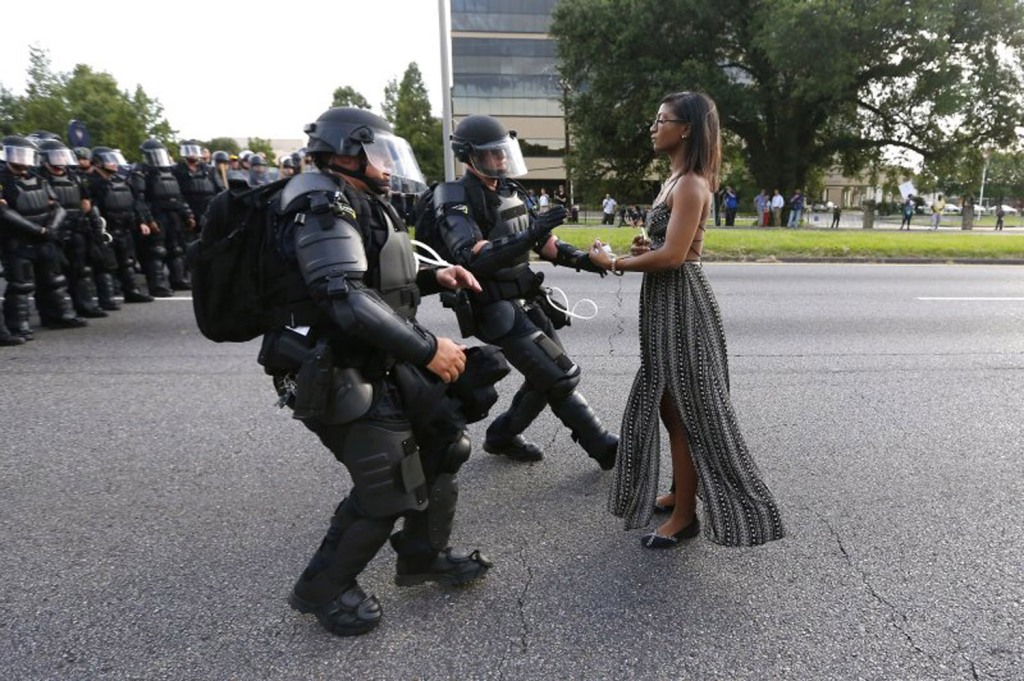
 Educate All Students, Support Public Education